Sunday, October 3, 2010
Two and a Half in the Family
Family-based situation comedy sitcoms on television have come a long way from what they used to be. Though evolution has occurred, there exist many differences and similarities between the past and the present. In the 1970s, All In The Family was a controversial sitcom that depicted several real-life issues which may have been considered unsuitable to be aired. In the contemporary series, Two and a Half Men, similar issues are dealt with, but the messages to the viewers are portrayed in a different way, and are less controversial.
In All In The Family, the protagonist, Archie Bunker, a white veteran of the war, is portrayed as being homophobic and racist, not wanting to associate himself with anyone who doesn't share the same views as him. He is conservative and prejudiced, acting as a character foil to his son-in-law, Michael, who is a liberal and open-minded hippie.The setting is in modern day (1970s) Queens, New York City.
In Two And A Half Men, which takes place on the other side of the country, in California today, the main character is a middle-aged, carefree bachelor named Charlie Sheen, who feels as if pleasure is the only intrinsic good. He lives with his twice-divorced brother, Alan, who is quite the opposite of Charlie, uptight and conscientious, and his young, lazy son, Jake. Charlie is depicted as a man who often objectifies women, but still has a good heart.
There is an obvious difference in the family structures of the sitcoms. Archie's family is more traditional, while Charlie's family is atypical and dysfunctional.
In both shows, even though the protagonists have morals that are questionable and attitudes that may not be viewed as positive, both are still lovable. Also, there exists an obvious character foil between two of the main characters; between Archie & Michael in All In The Family, and between Charlie & Alan in Two And A Half Men.
There is a character that serves as the main source of comic relief. In All In The Family, it is Edith, the wife of Archie, who often says something comedic in a tense situation. In Two And A Half Men, it is Berta, the housekeeper, who makes sarcastic remarks that bring a smile to the faces of the viewers.
All In The Family deals with topics such as homosexuality, racism, rape, and woman's liberation. Though Two And A Half Men addresses similar issues too, it is often portrayed in a less serious and more comical way. The main issue being dealt with in Two And A Half Men is the depiction of women and their dehumanizing and devaluing, which is not seen much in All In The Family.
With their differences aside, both All In The Family and Two And A Half Men are able to address controversial, real-life issues in a lighthearted and fun manner. Though times have changed, a positive light is able to be shined upon prejudices and viewers are able to be more aware of what is/was going on in the world around them.
Sunday, September 26, 2010
Evolution of Radio
In the 1920s, several factors aided with the formation of the radio industry. From government intervention to audience demand, there is one force that I believe stands out from the rest. Technological change, in my opinion, was the strongest factor which impacted the radio industry and had the biggest influence in shaping it, and technology is what was able to bring all the other factors into play, as well.
A huge demand for radios boomed in the 1920s, and Americans everywhere attempted to get their hands on one to use as a form of entertainment for the entire family. The innovations for the radio industry were provided by the technological changes. The audience was able to develop interests thanks to technological advancements. There were more radio channels in existence, which catered to the minds of any listener. Also, the radio is what was able to introduce music to people, as well. With FM radio, more people would be able to listen to the radio, and with a better sound quality, too. Advancements like these are what made the radio more attractive to Americans.
Without the existence of technological advancements, there would be no intervention, regulation, industries, or even audience demand. Technology is what was able to transform the radio into an actual industry.
Guglielmo Marconi was a man who helped greatly with the advancements of the industry. With his wireless transmitter, not only were the lives of several people able to be saved during the Titanic incident, but it also went on to transmit entertainment to the country in the 1920s.
Technological changes are what keep the world advancing, and without them, the radio industry would never have been able to experience such a boom as it did in the 1920s.
Sunday, September 19, 2010
Social Learning
The way we view everyday life is greatly impacted by social learning. The media is responsible for the way people learn how to react to certain events and situations. What is seen in the media is how the people viewing it will act, imitating what they see. We humans are easily influenced, which is why social learning has been in existence for quite a while now. The social learning theory aides in the understanding of the impact of the images seen in Tough Guise and Killing Us Softly.
In the documentaries Killing Us Softly and Tough Guise, the social learning theory is clearly able to be seen by the viewers. They both explain how males and females are portrayed in the media, and the way that they are presented is what we are so used to seeing. The "normal" female is passive and dominated by the male, used only for their own selfish purposes. The "normal" male has to put on a front of being strong and tough in order to be accepted by society. This is able to be seen in most fashion advertisements.
The male always dominates the female, who is seen as only an object, in a sexual way. Also, there is another negative message being given off by such ads. The "perfect" body is often portrayed, which brainwashes young people into thinking that what they see in the ad is what they should also see in the mirror.
From toddler days to adolescence to adulthood, the social learning theory has always had an impact on the lives of everyday people.
In the documentaries Killing Us Softly and Tough Guise, the social learning theory is clearly able to be seen by the viewers. They both explain how males and females are portrayed in the media, and the way that they are presented is what we are so used to seeing. The "normal" female is passive and dominated by the male, used only for their own selfish purposes. The "normal" male has to put on a front of being strong and tough in order to be accepted by society. This is able to be seen in most fashion advertisements.
The male always dominates the female, who is seen as only an object, in a sexual way. Also, there is another negative message being given off by such ads. The "perfect" body is often portrayed, which brainwashes young people into thinking that what they see in the ad is what they should also see in the mirror.
From toddler days to adolescence to adulthood, the social learning theory has always had an impact on the lives of everyday people.
Sunday, September 12, 2010
"I'm sorry that people are so jealous of me... but I can't help it that I'm so popular. "
As the sun rises and the birds chirp, another day at Hegemony High School is about to commence. We all are students attending there, whether we like it or not. Are you part of the dominating social group? Will you try to impose your views on the lesser groups? Well, the media essentially functions as a high school.
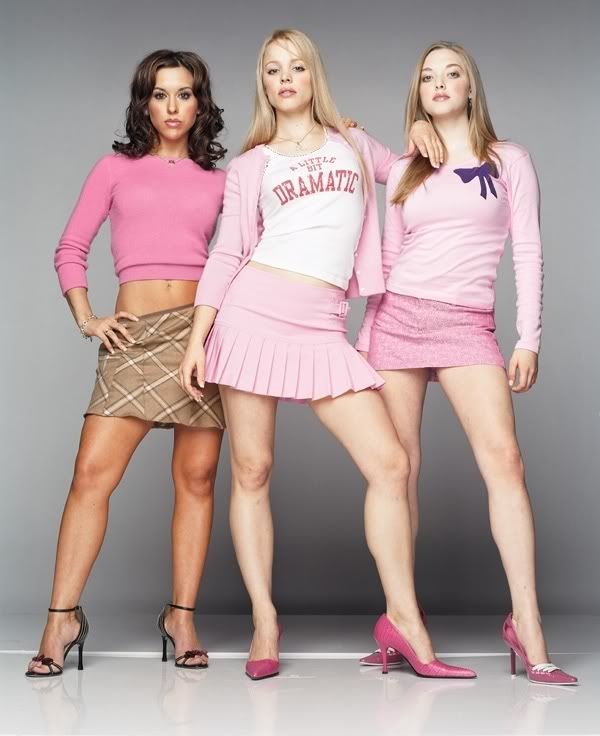
Let's use the fictional North Shore High School from Mean Girls as an example for understanding hegemony.
Composed of several unique cliques, there is still one ruling power that towers above the rest.
We have:
Freshmen,
ROTC Guys,
Preps,
J.V. Jocks,
Asian Nerds,
Cool Asians,
Varsity Jocks,
Unfriendly Black Hotties,
Girls Who Eat Their Feelings,
Girls Who Don't Eat Anything,
Desperate Wannabes,
Burnouts,
Sexually Active Band Geeks,
the Greatest People You Will Ever Meet,
and the worst:
...The Plastics, dominating this monkey-see, monkey-do world.
Reality television, for example, functions similar to the Plastics, ruling the world of culture. After all, everyone wants to be a Plastic, right? Reality shows such as Jersey Shore, Gossip Girl, and America's Next Top Model pretty much brainwash the viewers into wanting to become what they see on television, making them feel like what is being portrayed is normal and everyone should conform to the norm. When someone watches an episode of Jersey Shore, which has become so widespread among teens, a person will want to adapt to the Guido lifestyle as seen on television, using Snooki and Pauly D as inspiration for how to act. When a young girl watches an episode of America's Next Top Model, she will be given false hope by Tyra, thinking that she, too, can someday walk in the heels of the strutting beauty owning the television set.
http://www.youtube.com/watch?v=ZE5JKrU_VxQ
In the above clip from America's Next Top Model, the model is praised by Tyra for being skinny, tall, and having an extremely small waist. Female viewers want to become what is seen on television, and they would try to imitate what they have just witnessed, because the body being shown is portrayed as normal and desirable, so they feel like they must look the same way.
No matter what is on television, it will be sure to create a world of fantasy for those watching, a world which seems to be normal, for the viewer, and impose views upon the non-Plastics, who will do anything to fit in and be accepted by Regina George.
Let's use the fictional North Shore High School from Mean Girls as an example for understanding hegemony.
Composed of several unique cliques, there is still one ruling power that towers above the rest.
We have:
Freshmen,
ROTC Guys,
Preps,
J.V. Jocks,
Asian Nerds,
Cool Asians,
Varsity Jocks,
Unfriendly Black Hotties,
Girls Who Eat Their Feelings,
Girls Who Don't Eat Anything,
Desperate Wannabes,
Burnouts,
Sexually Active Band Geeks,
the Greatest People You Will Ever Meet,
and the worst:
...The Plastics, dominating this monkey-see, monkey-do world.
Reality television, for example, functions similar to the Plastics, ruling the world of culture. After all, everyone wants to be a Plastic, right? Reality shows such as Jersey Shore, Gossip Girl, and America's Next Top Model pretty much brainwash the viewers into wanting to become what they see on television, making them feel like what is being portrayed is normal and everyone should conform to the norm. When someone watches an episode of Jersey Shore, which has become so widespread among teens, a person will want to adapt to the Guido lifestyle as seen on television, using Snooki and Pauly D as inspiration for how to act. When a young girl watches an episode of America's Next Top Model, she will be given false hope by Tyra, thinking that she, too, can someday walk in the heels of the strutting beauty owning the television set.
http://www.youtube.com/watch?v=ZE5JKrU_VxQ
In the above clip from America's Next Top Model, the model is praised by Tyra for being skinny, tall, and having an extremely small waist. Female viewers want to become what is seen on television, and they would try to imitate what they have just witnessed, because the body being shown is portrayed as normal and desirable, so they feel like they must look the same way.
No matter what is on television, it will be sure to create a world of fantasy for those watching, a world which seems to be normal, for the viewer, and impose views upon the non-Plastics, who will do anything to fit in and be accepted by Regina George.
Subscribe to:
Posts (Atom)